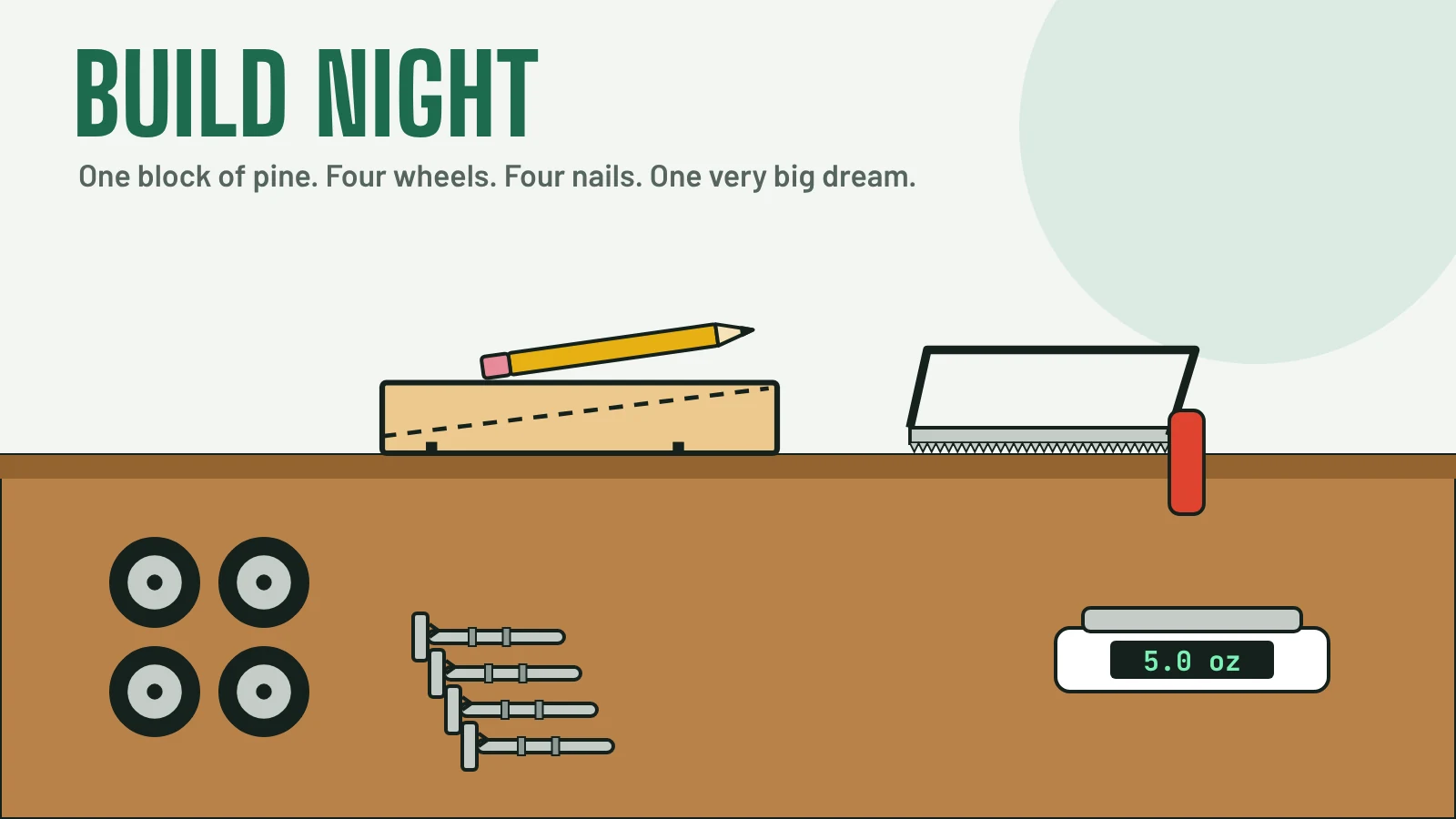
Pinewood derby weight: how much, and where to put it
Bring the whole car as close to your pack's limit as you can, usually 5 ounces. Put the weight toward the back and low, so the car balances about three-quarters of an inch to an inch in front of the rear axle. Keep it centered side to side, glue it down, and leave a little room for putty so you can top up on the official scale.
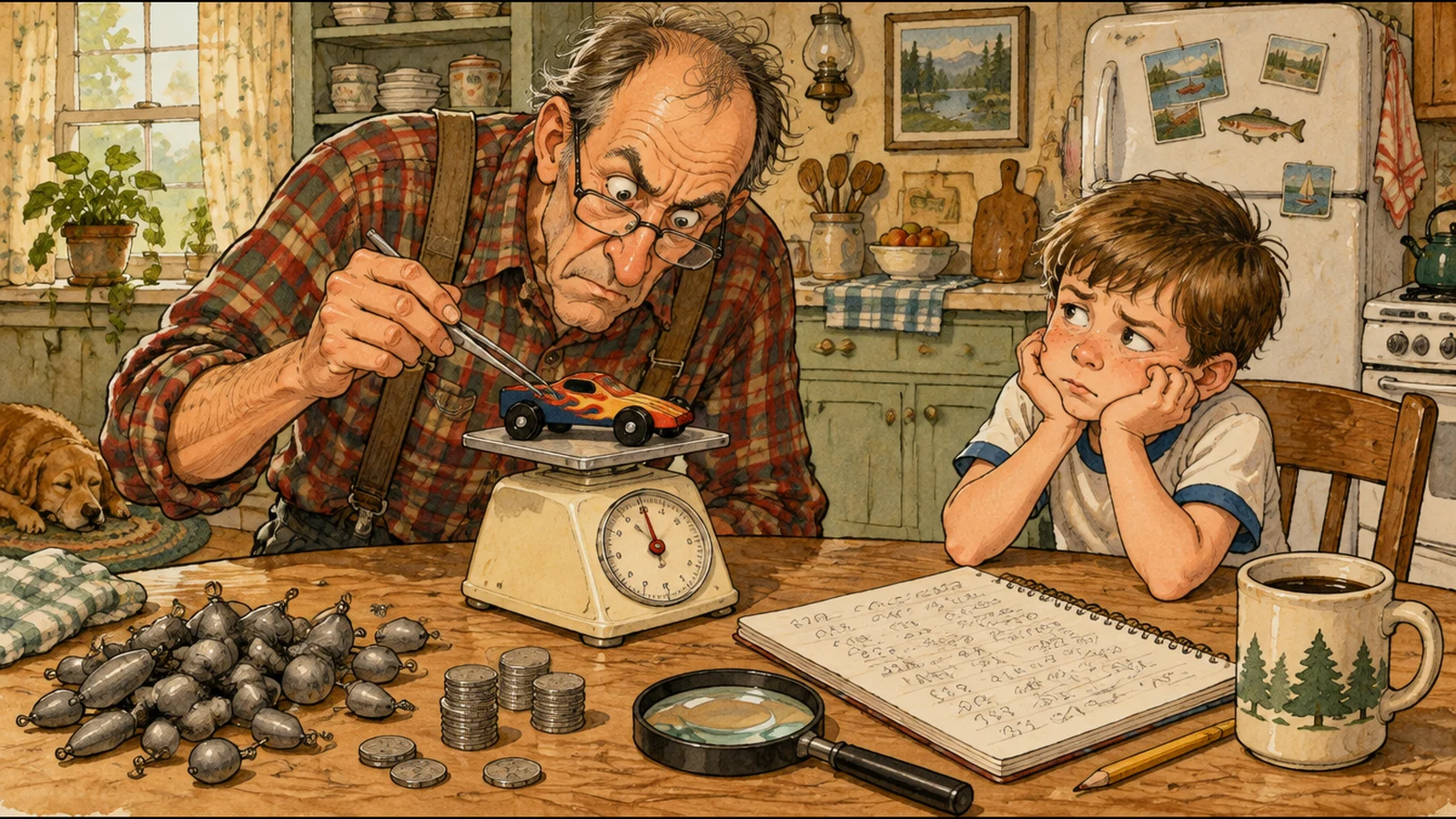
My neighbor Orvel Tunk owns three scales. One is in his kitchen, one is in his garage, and one is a jeweler's scale he bought from a man at a gun show who swore it had once weighed a diamond for a duchess. Orvel uses all three to weigh his pinewood derby car and then takes the average, because, as he puts it, "the truth is in there somewhere."
When Dwight, my eight-year-old nephew, asked Orvel how much weight to put in his car, Orvel set down his coffee, took off his glasses, and said, "All of it, son. All of it." Then he spent forty minutes explaining what he meant. I'll save you the forty minutes.
Why weight makes a car faster
A pinewood derby car has no motor. Everything it has comes from where it starts: up at the top of the track. The heavier the car, the more energy it carries down the slope.
Every car also loses some of that energy along the way, to the axles rubbing, the wheels scuffing the center strip, the air in the gym, and the work of getting four wheels spinning. Some of those losses, like the air and the wheels, stay about the same no matter how heavy the car is, so a heavy car loses a smaller share of what it has. That's why a 5-ounce car beats a 4-ounce car built the same way nearly every time. It isn't that heavy things fall faster. It's that heavy cars waste a smaller part of their energy.
Engineers at Duke University put numbers to this. In their model, doubling a car's mass changed the finish speed more than 15 times as much as doubling how far back the weight sat (Mann, Gibbs and Sah, 2012). How much weight comes first; where it goes comes second.
So the first rule is simple. Finish as close to the limit as your rules allow, without going over. Most packs use 5 ounces with the wheels and axles on, but check your rule sheet. Orvel races in an adult division where some joker once got the limit raised to 5.5, and he has never forgiven him.
How much weight you'll need to add
Less of the car is wood than you'd think. It depends on how much you cut away, but once the car is shaped, sanded and painted, most cars need roughly 2 to 3½ ounces of added weight to reach 5. Thin, low cars sit at the high end of that, and a chunky car that kept most of its block sits at the low end.
Weigh as you go, not just at the end. Put the body, all four wheels and all four axles on the scale together, because that's how the official scale will see it. Then add weight until you're at about 4.8 ounces, finish the car, and do the last little bit at weigh-in.
Check your kitchen scale with coins before you trust it. A U.S. nickel weighs 5 grams, so ten nickels should read 50 grams, or about 1.76 ounces. Twenty-eight nickels come to 140 grams, just under 5 ounces. Orvel checks all three of his scales this way every year, and every year they disagree.
Where to put it: the balance point
Here's where the real speed is. Put the weight toward the back of the car, so the car balances about three-quarters of an inch to an inch in front of the rear axle.
The reason is the slope. When the car sits at the starting pin, its back end is higher up the track than its front. Weight in the back starts higher and drops farther before the track flattens out, so it gives the car a little more energy to spend on the flat. It's the same reason you'd rather start a sled ride from the top of the hill than halfway down.
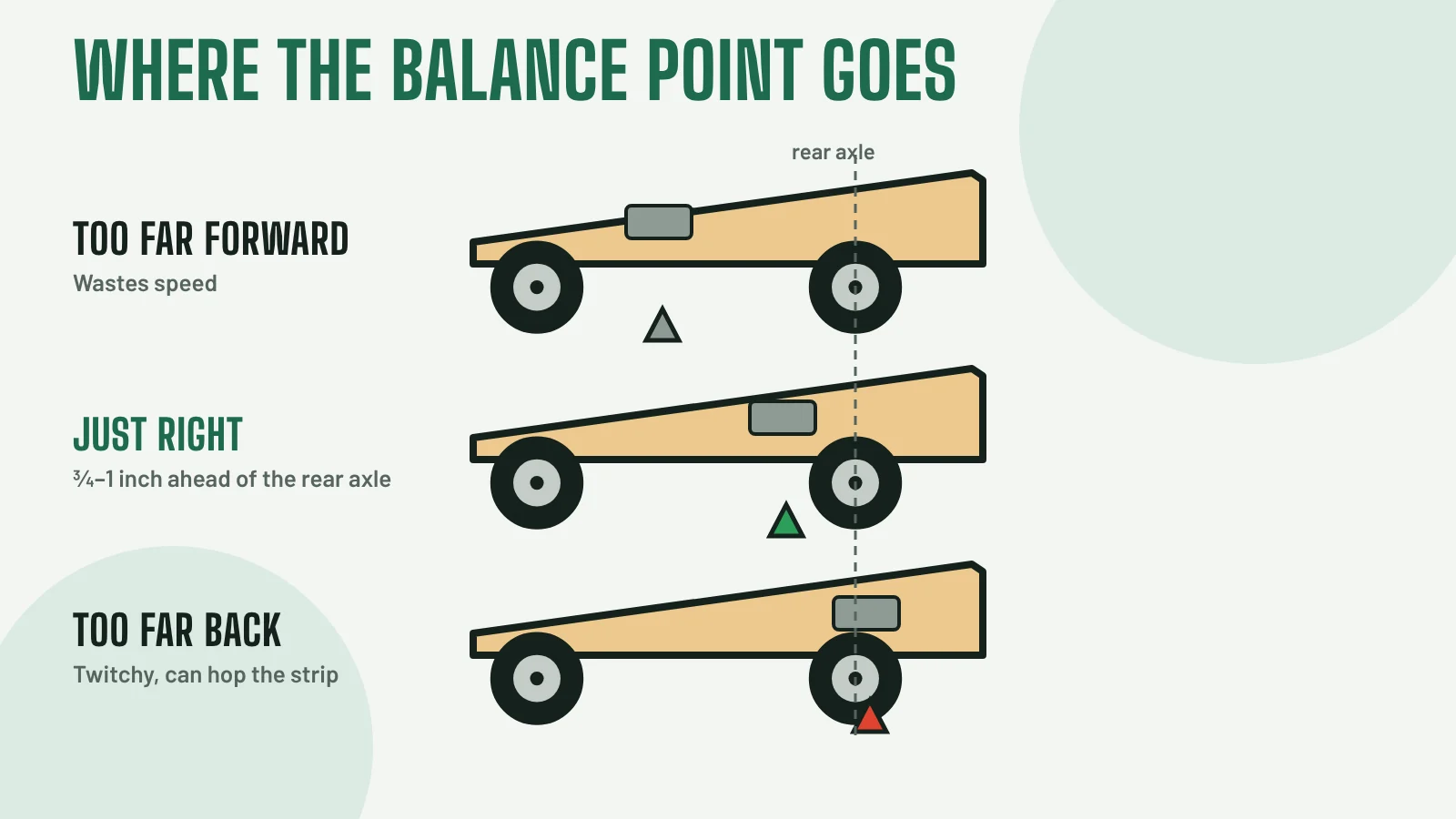
The experts don't all agree on the exact spot, but they're close. Maximum Velocity says three-quarters of an inch to an inch in front of the rear axle. Derby Dust says half an inch to an inch, and recommends a full inch for a first car or a wooden track with bumpy joints, because a car with a bit more weight up front is steadier. The Duke study's answer was “just in front of the rear axle.” For a first car, aim for about an inch and you won't go wrong.
To find your car's balance point, set it across a pencil or the edge of a ruler laid on the table. Slide it back and forth until it balances. That spot is the balance point. Mark it with a bit of tape and measure from there to the rear axle.
If it balances too far forward, move weight back. If it balances right over the rear axle or behind it, move some forward. This is much easier with the wheels off and the weights only taped in place, which is why you check it before you glue anything down.
Too far back is a real thing
Orvel learned this one the hard way. A few years ago he decided that if weight in the back was good, all the weight in the back must be great. He built a car with the balance point a quarter inch behind the rear axle and called it the Rocket Sled.
The Rocket Sled left the gate like it had somewhere to be. It also lifted its front wheels off the track at the bottom of the slope, came down crooked, and spent the rest of the run bouncing off the center strip like a pinball. The Cubmaster called it "the most exciting last place I've ever seen."
When the balance point gets too close to the rear axle, the front wheels carry almost nothing. The car wanders, rubs the center strip and sometimes hops. You lose more time to that than you gain from the extra height. Keep the balance point at least three-quarters of an inch in front of the rear axle, and if your car seems twitchy in testing, move a little weight forward.
One honest caveat. A physics student at the College of Wooster tested weight placement on a plain, uncut block with untouched kit wheels and found it made little difference (Schattgen, 2015). That fits the Duke ranking: friction in the wheels and axles swamps everything else. Weight placement starts to pay once the axles are polished and the car rolls straight, so don't skip those for this.
Keep it low and centered
Two more things decide how well the weight works.
Keep it centered side to side. A car that's heavier on one side leans on those wheels, and they rub harder. Put weights in pairs or in a row across the middle of the car.
Keep it low. The Duke study found that lowering the weight helps speed too, about a quarter as much as moving it back, and weight sitting high on top makes the car tippier and more likely to wobble. Weight set into holes drilled in the body, or into a pocket cut in the bottom, sits low and stays put. On a thin car with no room inside, flat weight plates on the bottom or set into the top both work, as long as they stay within your rules' clearance and height limits.
Ways to attach the weight
There are three common ways to get weight into a car.
- Holes drilled in the back of the body, either into the rear end or down from the top, filled with tungsten cylinders. This is the easiest way to get weight both low and toward the back. Drill them before you cut the shape, while the block still sits flat.
- A pocket cut into the bottom of the car, filled with weight and covered with a thin piece of wood or tape. It keeps the weight low and hidden, which matters if your kid has an elaborate paint job planned.
- Weights glued or screwed onto the top or bottom. It's quick, it's fine for a first car, and it's easy to adjust, but stay inside the clearance and height limits.
Tungsten is the densest common weight, so you can fit the most into the least space, right where you want it. Steel and zinc are cheaper and bigger. Whatever you use, fix it in so nothing moves or rattles. Most rules require that, and many spell out how: the Difficult Run District's 2026 rules, for one, allow permanent glue, nails, screws or coin pockets and ban tape and wet glue. Magnets and anything that moves are banned almost everywhere. A rattling car loses anyway.
Leave yourself a small shallow hole somewhere near the balance point for tungsten putty. That's your adjustment knob on race day.
Weigh-in night
The official scale will not agree with your kitchen scale. It never does, and it is not personal. Bring the car in at around 4.8 or 4.9 ounces, then bring a pinch of tungsten putty and a toothpick. Press in a little at a time until the official scale reads the limit, or one hair under it. Don't go over. Many races don't round at all, so 5.01 is over, and a few set the limit a hair higher, like 5.04 ounces. Check yours. A car that reads over gets sent back to the pit with a lot of people watching.
Orvel brings all three of his scales to weigh-in. The race committee asked him to stop in 2019. He still brings them. He just doesn't take them out of the bag.
If you'd like to see how weight placement changes a run before you drill anything, try the car simulator. You can move the weight around and race the result as many times as you like, with no glue involved. And if you haven't built the car yet, start with how to make a pinewood derby car.
What Dwight did
Dwight listened to all forty minutes of Orvel. Then he drilled three holes in the back of his car, filled them with tungsten, set it on a pencil, and got a balance point seven-eighths of an inch in front of the rear axle on the first try.
Orvel looked at it for a long time. Then he went home and moved the weight in his own car forward a quarter inch. He hasn't mentioned it since, and neither have we.